AFTER THE FIRE
Memories, Bodies and Conflicts in Contemporary African Art
by Antonella Pisilli
Black Liquid Art Gallery presents After the Fire. Memories, Bodies and Conflicts in Contemporary African Art, a group exhibition featuring eleven African and diaspora artists, on view from 24 April to 14 June 2025 at Via Piemonte 69, Rome. The exhibition is part of Raw for Peace, an international event dedicated to art as a tool for reflection on conflict and peace.
There is a moment in the history of an era when the word peace ceases to have meaning: not because the world has forgotten it, but because war has stopped being an event and has become a condition. We are in that moment. In Europe, the Middle East, and Asia, conflicts multiply with the speed of those who have nothing left to lose; but it is the African continent that carries the oldest and darkest weight of this condition,one that the Western world stopped looking at long ago because it no longer surprises. Today in Africa there is no single front: war is diffuse, fragmented, permanent. It is not fought along a single line, but everywhere and always, in the forests of the Congo, in the cities of Sudan, in the outskirts of the Sahel, on the plains of Mozambique. A conflict without a name, without a start date, and without any promise of an end, consuming lives, communities, and cultures with the same inexorable constancy with which fire consumes whatever it finds.
Contemporary African art is born inside this condition, not at its margins. The artists who inhabit it do not observe it from the outside: they carry it in their bodies, in their memory, in the form they choose to express themselves. And form, this is what art history teaches, from Goya to Picasso, from Jenny Holzer to Ai Weiwei, is not a neutral container for content: it is itself thought, judgment, a taking of sides. When Kambutzi layers the hallucinatory colors of his expressionism onto the violence of apartheid, when Mabunda transforms weapons into thrones, when Kwame Akoto paints war as a cosmic battle between good and evil, they are not illustrating history: they are questioning it, judging it, refusing it.
After the Fire brings together eleven African and diaspora artists for whom conflict is not a theme but the very territory of existence and inquiry. The title promises no redemption: the fire has already passed, or perhaps it has never stopped. What remains the ashes, the scars, the marks incised into matter and memory, is the true subject of this exhibition. What art can do is not extinguish the fire: it is to give it form, to restore to it the human dimension that politics and history systematically strip away, to open a space in which that dimension can be recognized, processed, and passed on.
Lovemore Kambudzi touches the rawest and most direct point of this inquiry. His large painting Apartheid — soldiers in camouflage beating civilians in a peripheral village, among shacks and shop signs that could be from yesterday or today, grants the viewer no safe distance: the yellow-green, almost hallucinatory colors, the expressionist density of the figures, the tangle of bodies and batons construct a visual field from which one cannot emerge unscathed. Kambutzi was born in Zimbabwe but trained and lived for many years in South Africa, and his work carries the living memory of an institutionalized system of racial segregation that marked the entire southern Africa for decades: apartheid not as a concluded historical fact, but as a trauma that continues to structure the present, to organize bodies in space, to decide who can be where and with what dignity.
Beside him, Mario Macilau (Mozambico) conveys the same truth through the opposite medium: the black-and-white photograph of a child with a Kalashnikov held to his head, in Mozambique during the civil war, is an image that neither accuses nor aestheticizes, that seeks no effect and constructs no rhetoric of compassion. Macilau photographs the way one bears witness: with the awareness that the wound is already there, and that looking at it is enough.
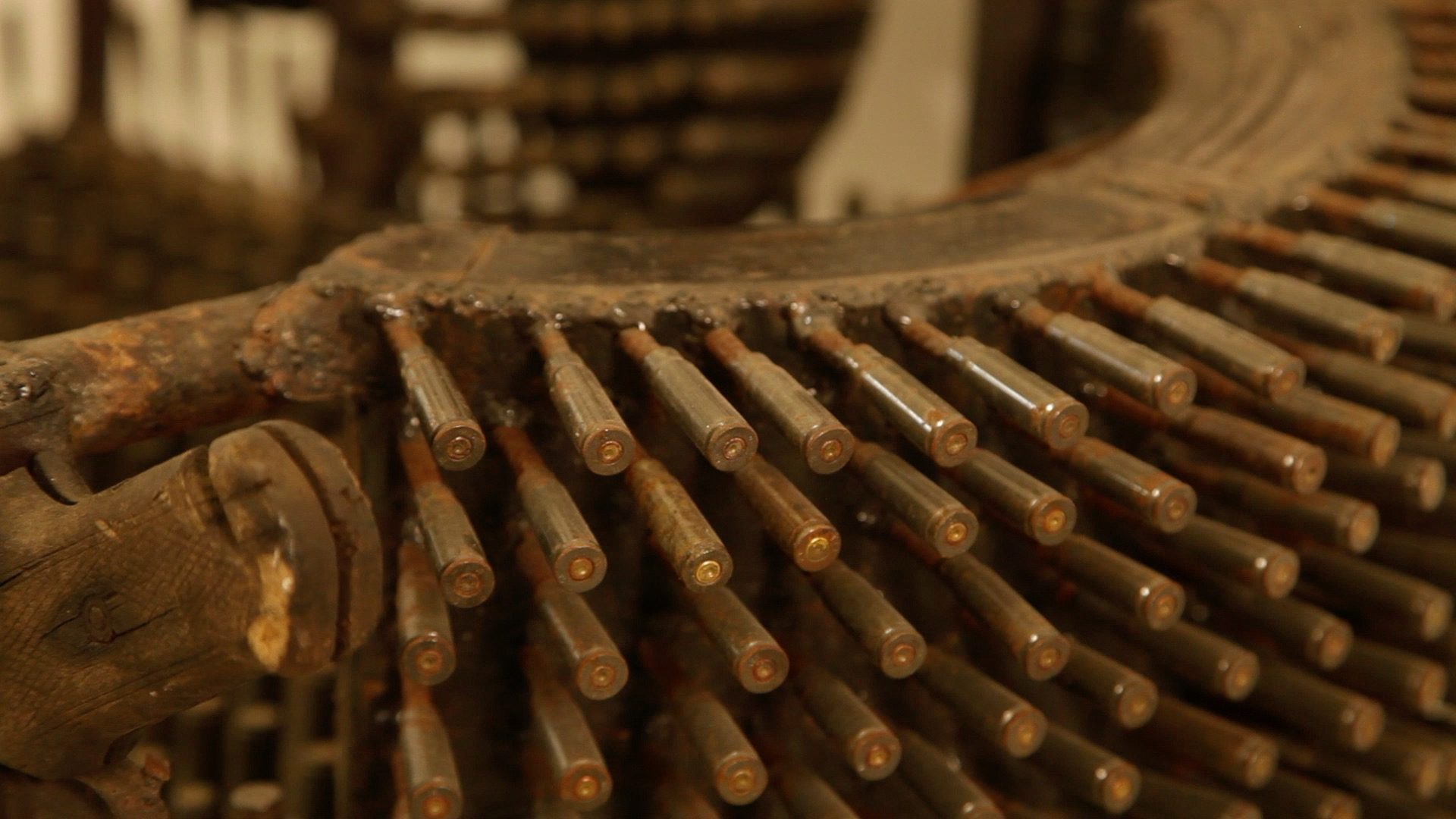
It is from a civil war, the Mozambican conflict of 1977–1992, one of the most devastating and least remembered in recent history, that the work of Gonçalo Mabunda (Mozambico)is born, perhaps the most politically charged piece in the entire exhibition. Mabunda collects the decommissioned weapons of that war rifles, bullets, military components whose function was to kill and transforms them into sculptures: thrones, masks, monumental figures. The throne on display, constructed entirely from disarmed military material, inverts the supreme symbol of power the seat from which one governs and commands into a monument to its own contradiction: power is made of the same things it uses to destroy. The mind turns to the tradition of the Congolese Nkisi Nkondi, the nail-studded fetishes in which each nail represented a pact, a wound, a prayer: in Mabunda, too, each incorporated weapon is an act of memory, a transformation of damage into meaning. The matter of death becomes the matter of art: not to exorcise it, but to ensure it is not forgotten.
The conflict running through the work of Godfried Donkor (Ghana) does not take the form of military violence: it takes the form of money, stock figures, trade routes that crossed the Atlantic for centuries first with enslaved people, then with goods. In his collages, female figures pasted onto pages of financial newspapers, colonial ships emerging from market data, bodies floating among listings and prices — Donkor constructs a precise and unflinching visual genealogy: the slave trade and contemporary financial capitalism are not two separate eras, but two phases of the same system of domination, two ways of reducing the human body to a commodity, a resource, an exchange value. The gold circle framing the head of the female figure is a halo: the historical victim elevated to icon, the colonized body restored to its dignity through the painterly gesture. But the halo does not erase the columns of numbers that surround it: it absorbs them, contains them, denounces them.
There is a gesture in the history of contemporary African art that is worth more than a thousand paintings: in 1948, following a mystical vision, Frédéric Bruly Bouabré (Côte d'Ivoire, 1923–2014) decided to invent an alphabet for his mother tongue Bété, creating a system of 449 syllables represented by small drawings on card accompanied by brief captions in French. In this gesture at once a linguistic, political, and spiritual act — the full anticolonial scope of his work is condensed: to give African culture an autonomous writing system is to free it from dependence on the language of the colonizer. Bouabré understood that the first form of colonial violence is not military but epistemic: it is the erasure of knowledge, the replacement of one language with another, of one cosmogony with another.
The works on display articulate this awareness through conflict as direct subject. In the series Val des guerriers aux épées, twenty cards depict mounted warriors in close combat: the vivid colors, pink, green, yellow, orange, create a deliberate visual short-circuit, violence rendered in an almost festive palette. The obsessive repetition of the same schema is structural: war repeats itself, always the same, in every era and place. This series finds its counterpoint in Dieu n'aime pas la guerre (2012), in which the flags of nations are accompanied by the title statement, repeated like a secular rosary. Individual works complete the cluster: La grande sabre du guerrier figurant ses victimes de guerre a blade occupying almost the entire card, with the bodies of victims incised within it is perhaps the most densely charged image in the entire exhibition. Acts of resistance before they are works of art.
At the center of the exhibition, as a hinge between physical and spiritual conflict, stands the work of Kwame Akoto Almighty God (Ghana), a visionary artist who brings to the show a dimension that no other work touches with the same radicalism: that of cosmic war, of the battle between the forces of good and evil that runs through human history and transcends it. In the painting By All Means Satan will Die, an angelic figure with feathered wings emerges from a blood-red background, shot through with beams of light like rays or bullets, a green serpent coiled at its neck, its gaze at once hallucinatory and resolute the gaze of one fighting a battle others cannot see. At the bottom, the inscription that gives the work its title and a citation from the book of Isaiah on Lucifer cast down from Heaven. Christian iconography merges with African visual tradition in an image of overwhelming and unsettling power: what Almighty God asserts, with the force of one who harbors no doubts, is that war is not only between armies and resources, between rulers and the ruled, but is first and foremost a spiritual battle, a conflict fought in the soul of peoples, one that, to be understood and to be won, requires a consciousness that goes far beyond politics and history. Evil has a face, has wings, has the bite of the serpent. And it can be defeated.
Gerald Chukwuma (Nigeria) responds to violence with the silence of transformed matter. The large panels in burned and incised wood, in tones of bronze and oxidized copper, with motifs recalling cosmogonies and ancestral alphabets, are surfaces that visibly carry the memory of fire: not the fire of destruction, but that of purification, of writing, of the transmission of knowledge across generations. Burning and incising wood is an act the African tradition knows well: it is the way stories are fixed, knowledge passed down, collective memory preserved against erasure. In Chukwuma, this ancestral technique becomes an aesthetic response to colonialism: the marks incised in the burned wood speak of cultures that resist, of identities that refuse to be reduced to silence, of a knowledge that survives because it is impressed into matter and does not depend on the colonizer's language to be transmitted.
Kayode Ejioye (Nigeria) brings conflict into its most contemporary and most pervasive form: that of cultural colonization, of domination no longer exercised through weapons but through brands, logos, the symbols of Western luxury that invade the bodies and identities of already-colonized peoples. The figure portrayed wears a uniform entirely covered in the Louis Vuitton monogram and sports a military beret: the superimposition is precise and fierce, almost surgical. The soldier's uniform and the luxury brand fuse into a single outfit, revealing what the economic and political history of the postwar period has tried to conceal: that military and economic domination have never truly been separate, that war does not end when the troops withdraw but continues, under another form, in markets, in consumption, in aspirations. The body of Kawote's figure is a battlefield. It always has been.
The work of Alex Peter Idoko (Nigeria) presents itself as a ritual of fire, but here fire is not a symbolically neutral element: it is the material of destruction, the direct trace of conflict. Working with a pyrograph, the artist does not represent fire: he incorporates it into the surface, transforming it into a field traversed by violence. In Strive, subject and technique coincide. The figure in the foreground blows toward the flames in a gesture suspended between the attempt to tame them and the ambiguous possibility of feeding them. The low-angle framing amplifies the tension: the body becomes monumental, the heat seems to escape the image itself. Beside him, a second body abandoned, head resting on a shoulder: a silent presence that introduces the human weight of suffering. This is not a narrative detail but a fracture in the scene, an element that shifts the image from gesture to experience, from action to consequence. In Idoko, fire is not purification but memory. The burned matter preserves the mark of destruction and transforms it into visual language: what we see is not only representation, but trace. The artist's gesture becomes an act of resistance, an attempt to hold within the burned surface what war consumes and erases.
John Hopex (Nigeria) brings to the exhibition the surgical precision of hyperrealism in service of an image that does not denounce war but interrogates its darkest nature. In Dangerous Liaisons, a female figure rendered in black and white embraces a golden bomb with abandon: she does not hold it out of fear, nor does she clutch it out of necessity. She holds it the way one holds what one loves. The chromatic contrast, the grey, almost photographic body against the gleaming, warm, almost precious weapon, frames the central question of the work: why do men rush toward war with the same irrational, inexorable passion with which they rush toward their own destruction? "Pace non trovo, et non ò da far guerra" wrote Petrarch in sonnet 134 of the Canzoniere, describing a passion the subject neither understands, nor justifies, nor can bring himself to break. It is the same logic Hopex depicts: power seduces as love seduces, promises what it cannot deliver, and those who embrace it know this. Is man condemned to surrender to the inexorable destiny of war, or can he still choose to resist the malice and greed of those who wield that power?
The exhibition closes with Owusu Ankomah (Sekondi, Ghana, 1956–2025), whose recent passing makes the works on display all the more precious and urgent. His painting in which Adinkra symbols, the iconographic system of Akan culture used for centuries to convey values, proverbs, and knowledge, cover the entire surface of the canvas while a face barely emerges from behind them, represents the culmination of a lifelong inquiry. Ankomah was not a painter of symbols, but a thinker who used them to construct an autonomous cosmological system capable of bringing precolonial African tradition into relation with the geometries of crop circles, quantum physics, and Eastern philosophy. He developed the concept of the Microcron: an absolute symbol condensing universes within universes, the expression of an eternal and infinite cosmological reality.
"The total number of minds in the universe is one," as he told me in an interview conducted years ago. In this statement is reflected an act of faith in the radical connection between all human cultures, as a response to the violence of racial, colonial, and economic separation, through the affirmation of unity.
The face barely visible behind the web of signs is not absence, but a presence waiting to be recognized. In Ankomah, conflict finds its most silent and most radical answer: vision as political act, the persistence of culture as the supreme form of resistance.
After the Fire offers no resolutions. It is not art's task to resolve war: that is the task of politics, which often renounces it. But the works in this exhibition demonstrate that art can do something politics cannot achieve with the same precision: restore to conflict its human, individual, bodily, and spiritual dimension, the dimension that war systematically erases by reducing human beings to numbers, to fronts, to collateral effects. And to open, through form, a space in which that dimension can be recognized, processed, and transmitted. Not the end of the fire is what remains after.